


Uganda Industry News
UPDF Engineers Deliver 87% Complete MoDVA HQ by 2026
Gen Muhoozi Kainerugaba commends UPDF Engineering Brigade as the new MoDVA/UPDF Headquarters at Mbuya reaches 87% completion, set for December 2026 commissioning.
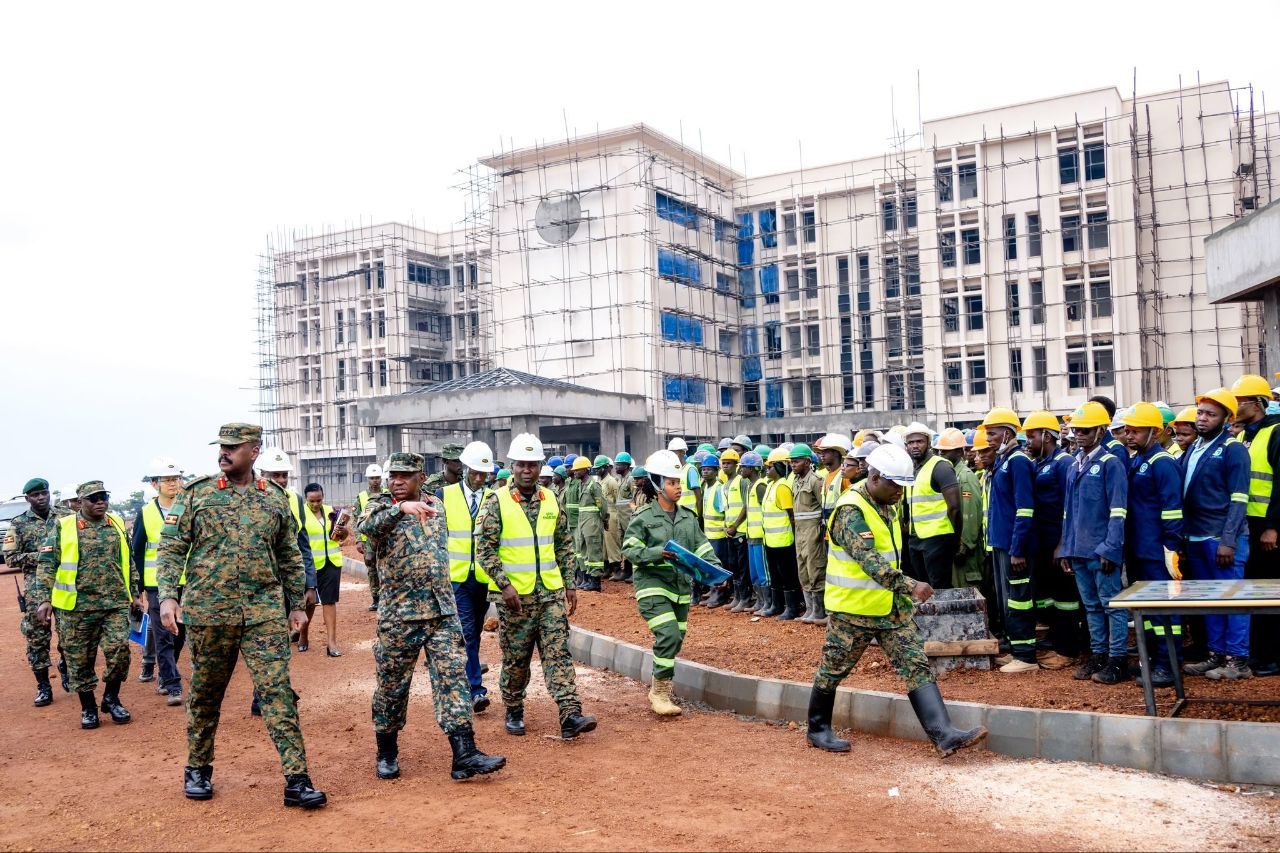
There is a moment on Mbuya Hill, usually just after the morning parade has dispersed and the machines have warmed up again, when the scale of what Uganda is building for itself becomes impossible to ignore. Two towers rise from the ridge, their skeletons long since dressed in concrete and glass, and from the Kampala side of the hill they now catch the late afternoon light like a statement rather than a structure. When the Chief of Defence Forces, Gen Muhoozi Kainerugaba, climbed that hill on September 14, 2026, for yet another inspection tour, he was not walking onto a construction site so much as into the final act of a project that has quietly become one of the most consequential infrastructure stories in the country. The new Ministry of Defence and Veteran Affairs and UPDF Joint Headquarters now stands at 87 percent complete, and the commissioning date of December 2026 no longer sounds like an aspiration. It sounds like a countdown.
What makes this project worth more than a passing mention in the daily news cycle is not simply the percentage, satisfying as that number is. It is who is doing the work. The twin tower complex at Mbuya is being built entirely by the UPDF Engineering Brigade, soldiers who swapped the parade ground for the site plan and who have, over the years, become one of the most quietly effective construction forces in the region. Gen Muhoozi's commendation during the inspection tour was directed squarely at those engineers, and he was reported to have expressed satisfaction not just with the pace but with the quality of the finish. The message was clear and it was deliberately pointed: this is Ugandan capacity, Ugandan discipline, and Ugandan money turning into a Ugandan institution.
The figures behind the project tell their own story. The complex is estimated to have cost in the region of UGX 94 billion, a figure that in the hands of a foreign contractor would have bought a great deal less building and a great deal more paperwork. That number matters because it feeds directly into a conversation Ugandans have been having for years about value for money in public works. When a national army builds its own command headquarters, the audit trail is shorter, the skills stay home, and the money circulates within the local economy in ways that a contract awarded abroad simply does not allow. The engineers who pour that concrete today are the same professionals who will maintain the complex for the next three decades. That is not a small thing. That is institutional memory being poured into the foundation.
The design itself speaks to a shift in how the defence establishment understands its own work. The twin tower arrangement, with its advanced communication, command, and digital systems, is not merely a prettier version of the old scattered office blocks. It is a physical argument about coordination. For years, the ministry and the defence forces have operated across multiple locations, with the inevitable friction that comes when the people who make policy and the people who execute it are separated by traffic on Jinja Road. Bringing them onto one hill, into one integrated command hub, is the kind of reform that never makes a dramatic headline but quietly changes how decisions get made. Modern infrastructure, stronger coordination, stronger UPDF, stronger Uganda. The slogan on the project brief is unusually honest for a government communications line, because in this case the logic actually holds.
There is also a veterans dimension here that deserves more attention than it usually receives. This is the Ministry of Defence and Veteran Affairs, not just the Ministry of Defence. Uganda has a large and growing population of retired service personnel, men and women who gave the best years of their lives to uniformed service and who too often find themselves navigating a bureaucracy that was never designed with them in mind. A headquarters built to modern standards, with digital systems and proper records management, is not a vanity project for generals. It is the back office that determines whether a veteran's pension is processed in weeks or in years, whether a widow's claim is verified or lost in a filing cabinet. When the CDF says the engineers' hard work will be specially recognised upon completion, he is speaking about a building, but the building is ultimately about people who no longer wear the uniform.
It is worth placing this project in the broader context of Uganda's current infrastructure moment, because Mbuya Hill is not an isolated story. The country is in the middle of an unusually busy season of national construction, from transport corridors to energy projects, and the question of local execution capacity has become central to all of it. Parliament has been actively benchmarking regional rail and cargo systems, as seen in the ongoing discussions around Uganda MPs benchmarking Kenya Railways for 2026 cargo, and the same logic of self-reliance that drives those conversations drives the UPDF Engineering Brigade's growing portfolio. The difference is that the army engineers have been delivering for years without much fanfare, and the Mbuya complex is simply the most visible proof of concept.
The September inspection tour also carried a subtle political and institutional message that Kampala's chattering class did not miss. Gen Muhoozi has made a habit of being physically present at the sites and ceremonies that matter to the defence establishment, and the language around his leadership has increasingly emphasised hands-on oversight rather than ceremonial distance. The commendation of the Engineering Brigade fits that pattern precisely. It rewards a unit that has historically been underappreciated within the broader force structure, and it does so publicly, in front of the cameras, with a promise of special recognition at completion. For the engineers, that is not just morale. That is career capital. For the institution, it is a signal that competence gets noticed at the very top.
None of this means the project has been without the usual pressures that attend any major public construction in Uganda. Weather, supply chains, and the sheer complexity of installing advanced digital command systems into a building that must also meet security standards most contractors never encounter all create room for delay. The fact that the project remains firmly on schedule at 87 percent with the commissioning date still set for December 2026 is therefore a genuine achievement, not a routine update. Anyone who has watched a public building crawl toward completion for a decade knows how rare that is. The engineers deserve the credit, and they deserve it without the usual caveat that something must be wrong somewhere.
What happens after December 2026 will be the real test. A headquarters is only as good as the culture that moves into it. The digital systems, the command suites, the communication arrays, all of it will be tested not on commissioning day but in the years that follow, when the building has to function as the nerve centre of a national defence establishment operating in a complicated region. The structure at Mbuya will not make Uganda safer on its own. But it will remove excuses. When the ministry and the command are under one roof, with modern tools and a unified chain of information, the quality of decisions becomes harder to blame on the environment. That is a healthy kind of pressure to place on an institution.
There is a quieter point to make as well, one that rarely makes it into official statements. Uganda has spent much of its post colonial history importing expertise for its most important buildings, from hospitals to hotels to government offices. The sight of soldiers in uniform pouring concrete, reading blueprints, and managing complex installations on a hill in Kampala is a statement about what the country has learned to do for itself. It connects to a longer tradition of military engineering in the region, and it sits comfortably alongside the renewed energy in Uganda's creative and cultural sectors, where local production is also finding new confidence, much like the resurgence documented in the story of why Kampala live band music is booming again. Different industries, same underlying shift. Uganda is increasingly doing its own thing, in its own way, with its own people.
As the year turns toward December 2026, expect the Mbuya complex to become a fixture of national conversation. There will be drone footage of the twin towers against the Kampala skyline. There will be commentary about the cost, the design, and the symbolism. There will be the usual debates about priorities. All of that is healthy. But underneath the noise, something concrete is happening on that hill, and it is being done by Ugandans in uniform who were given a hard job and are finishing it on time. Gen Muhoozi's commendation was well placed. The real tribute will be the day the lights come on, the systems go live, and the ministry walks through its own front door.
Q: What exactly is being built at Mbuya Hill?
A: The project is the new Ministry of Defence and Veteran Affairs and UPDF Joint Headquarters, a twin tower complex designed to bring the ministry and the defence command under one roof. It includes advanced communication, command, and digital systems meant to modernise how the institution coordinates its work. It is being constructed entirely by the UPDF Engineering Brigade.
Q: How much does the project cost and who is funding it?
A: The complex is estimated at around UGX 94 billion, funded through national resources. Because the work is being done in house by military engineers rather than awarded to an external contractor, a larger share of that money stays within the local economy and builds permanent domestic construction capacity.
Q: When will it be commissioned?
A: The target is December 2026, and as of the September 14, 2026 inspection tour led by Gen Muhoozi Kainerugaba, the project stood at 87 percent complete and remained firmly on schedule. The CDF also indicated that the engineers' contribution will be specially recognised upon completion.
Q: Why does this project matter beyond the army?
A: Because it houses the ministry responsible for veterans, and because it demonstrates that Uganda can deliver complex national infrastructure using its own personnel. It also sets a benchmark for coordination and accountability, which ultimately affects how efficiently services reach retired service personnel and their families.
Keep reading
 Entertainment & Music
Angélique Kidjo Makes History on Hollywood Walk of Fame
The pavement of Hollywood Boulevard has absorbed a lot of history. It has taken the footprints of silent film stars, the handprints of action heroes, the brass letters of studios that built an empire out of dreams.
Mpabeat Support ·
 Celebrity & Entertainment
Pallaso Accused of Violent Attack on King Saha: 2026 Fallout
The Ugandan music industry woke up this week to a story it has heard too many times before, and yet the shock still landed like a bass drum in a silent room. Pallaso, the Mayanja family firebrand whose career has been built on equal parts melody and menace, stands accused of a violent attack on fellow singer King Saha.
Mpabeat Support ·
Celebrity & EntertainmentPallaso Accused of Violent Attack on King Saha
Kampala woke up to a storm it did not ask for. By midmorning, the city's timelines were clogged with the same breathless sentence, repeated in a dozen variations, each one slightly more dramatic than the last: Pallaso had allegedly attacked King Saha. No context. No confirmation.
Mpabeat Support ·