Tooro Burial Ritual: 9 Coffee Beans & Leopard Skin
Moses Mukisa
Head of Cultural Journalism • Published 13 September 2026
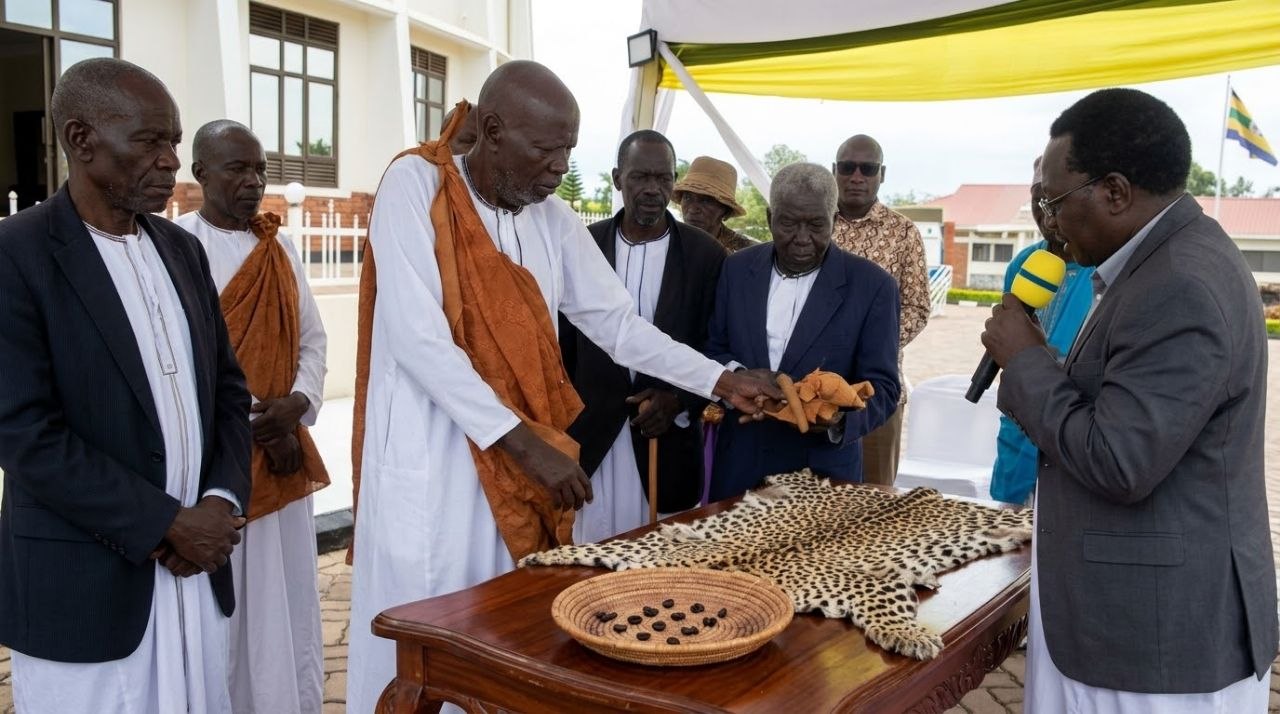
“King Oyo's burial rites reveal ancient Luo-Bito traditions binding Tooro and Acholi. Prince Edward Kijanangoma performed the sacred coffee bean ritual.”
The image that refuses to leave my mind is not the wailing, not the drums, not the sea of black cloth at the palace gates. It is nine small coffee beans, held in a prince's palm, then cast into the earth. Nine. Not eight, not ten. In Tooro, where ritual is precision and precision is power, the number is the message. When news broke that King Oyo's burial rites had unfolded according to the ancient Luo-Bito script, with Prince Edward Kijanangoma performing the sacred coffee bean ritual and a leopard skin sourced from Acholi completing the set, a lot of Ugandans reacted with the usual social media shorthand. Some called it superstition. Some called it clout. A few, the ones who actually read, called it what it is: a constitutional moment written in the language of ancestors.
Let me explain why this story matters far beyond the walls of the Karuziika palace. Tooro is not just a kingdom. It is a memory bank. And the memory bank, as the burial rites reminded us, does not close at the Uganda-South Sudan border. The Luo-Bito tradition is the thread that runs through Tooro, Bunyoro, Acholi, Alur, Jonam and beyond. It is a family tree that predates colonial maps by centuries. When a Tooro king is laid to rest, he is not buried merely as a Rwenzururu or Batoro monarch. He is buried as a descendant of the Bito, and the Bito are a Luo dynasty. That is not a controversial claim. It is the accepted genealogy of the Great Lakes region, taught in history departments from Makerere to Nairobi and largely ignored by the rest of us because it does not fit neatly into the ethnic boxes colonial administrators preferred.
The coffee bean, in this cosmology, is not a beverage. It is a covenant. In Luo-Bito ritual, coffee beans represent the seed of continuity, the promise that the line does not end at the grave. Nine beans are cast so that the departed king's spirit can negotiate its passage and so that the living can be reminded that authority is inherited, not improvised. The leopard skin, meanwhile, is royalty itself made animal. The leopard does not beg for respect. It simply arrives and the forest adjusts. In Acholi, the leopard is associated with chiefly authority and with the spiritual guardianship of clan land. That a leopard skin for a Tooro king's burial would be sourced from Acholi is not a logistical footnote. It is a diplomatic statement made in fur.
Prince Edward Kijanangoma's role in the ritual deserves more attention than it got. Here is a man whose name has been entangled in Tooro's succession politics for years, a prince who has at various points been cast as rival, as claimant, as troublemaker, depending on who was telling the story. And yet when the moment demanded ritual purity, it was his hands that held the beans. That is not a small thing. In African royal tradition, the person who performs the burial rite is not chosen by popularity. He is chosen by lineage and by spiritual fitness. The fact that Kijanangoma stood at that graveside and performed the casting tells us something about how Tooro's internal disputes are ultimately settled. Not in press conferences, not in court filings, but in the quiet choreography of tradition, where the family closes ranks in front of the ancestors and the public is left to decode the symbolism.
Of course, we cannot talk about this burial without talking about the politics that surrounded King Oyo's reign and the tensions that have gripped Tooro in recent years. The kingdom has been through storms. Accusations have flown in every direction, some of them grave enough to dominate national headlines and fracture family relationships in ways that no ritual can instantly heal. You can read some of that painful chapter in our reporting on the crisis that rocked Tooro when Mwenda accused the Queen Mother of murder and forgery. That context is important because it explains why the burial rites carried such weight. When a royal family is publicly divided, a shared ritual becomes the only room in the house where everyone must stand together. The coffee beans did not just bury a king. They buried, at least for one afternoon, a season of open conflict.
There is also a national dimension that Ugandans are too quick to overlook. Tooro and Acholi are often discussed in this country as if they belong to different universes. One is presented as a kingdom of ceremony and tourism, the other as a region of war memory and military recruitment. That framing is lazy and it is historically illiterate. The Luo-Bito connection means that the two regions share ancestry, ritual grammar, and chiefly institutions. When a leopard skin travels from Acholi to Fort Portal for a royal burial, it is not charity. It is family business. And in a country where regional suspicion is constantly stoked for political convenience, that kind of visible kinship is quietly subversive. It reminds us that Uganda's diversity was never meant to be a weapon. It was meant to be a web.
Let me also address the cultural tourism angle, because I am an entertainment editor and I refuse to pretend that symbolism has no market value. Uganda's traditional kingdoms are among the most under marketed assets this country has. We export musicians, we export athletes, we export labour. We barely export heritage. A burial rite involving nine coffee beans and an Acholi leopard skin is the kind of story that could anchor documentaries, museum exhibitions, and cultural festivals if we had the institutional confidence to package it. Instead, we let it live and die on WhatsApp statuses. The kingdoms themselves must take some blame, and so must our creative class. There is a whole generation of Ugandan filmmakers who would kill for this material and nobody is handing it to them.
There is a deeper lesson here about how we treat ritual in modern Uganda. We are a country that loves tradition on Instagram and distrusts it in practice. We will post the drums and the royal robes, then roll our eyes when an elder insists on a particular bean count. But ritual is not decoration. It is governance. It is the original constitution, written before paper, enforced by memory. The nine coffee beans are a reminder that Tooro's legitimacy does not rest on gazette notices or government subventions. It rests on the unbroken performance of rites that predate the Republic of Uganda itself. That is why the state watches kingdoms so nervously. Not because of the crowns, but because of the graves.
And we should be honest about the generational challenge. King Oyo came to the throne as a child and grew up in public, which means an entire generation of Batoro has never known another king. His burial therefore marks a genuine rupture, not just a transition. The young people who filled social media with tributes were not merely mourning a monarch. They were mourning a fixture of their childhood. The ritual, with its beans and its leopard skin, gave them something solid to hold. In an era where so much of Ugandan public life feels improvised, where institutions bend with every political breeze, here was a ceremony that refused to improvise. The number was nine. The skin was leopard. The hands were a prince's. No negotiation.
Critics will say this is all romanticism, that rituals do not pay school fees or fix roads. Fair. But rituals do something else. They tell a community who it is. And for a kingdom that has spent years fighting over identity, property, and succession, that clarity is not a luxury. It is infrastructure. You cannot build a functioning institution on lawsuits alone. You need a shared story about where authority comes from and how it passes. The Luo-Bito burial tradition is that story, and it is older and more durable than any of the disputes currently occupying Tooro's courts and press cycles.
What happens next is the real test. Ritual is a beginning, not a conclusion. The beans have been cast. The leopard skin has been laid. The ancestors have been addressed. Now the living must decide whether the unity performed at the graveside will survive the first disagreement over land, title, or money. History suggests it often does not. But history also suggests that every time Tooro has been written off, the kingdom has found a way to reassert itself through exactly this kind of ceremonial continuity. If you want to understand how Ugandan traditional institutions survive, stop watching the press conferences and start watching the burials. That is where the real politics happens, and it happens in whispers, in numbers, and in the skins of leopards.
Q: Why exactly nine coffee beans and not another number?
A: In Luo-Bito ritual practice, numbers are not arbitrary. Nine carries associations with completion and with the ancestral council, and it is tied to the idea that the departing king must be accompanied by a full set of spiritual witnesses. The precise meaning is guarded by clan elders, but the principle is that the number itself is part of the prayer. Change the count and you change the message.
Q: What is the Luo-Bito connection between Tooro and Acholi?
A: The Bito dynasty is widely understood to have Luo origins, and its influence spread across the Great Lakes region, shaping royal institutions in Bunyoro, Tooro, and Luo-speaking communities including Acholi and Alur. That shared ancestry is why a leopard skin from Acholi is considered appropriate, even necessary, for a Tooro royal burial. It is kinship expressed through ritual objects.
Q: Why does a leopard skin matter so much in this context?
A: The leopard symbolizes supreme authority and spiritual guardianship in many of the region's chiefly traditions. Placing it with the king is a way of restoring him to the fullness of his royal identity. Sourcing it from Acholi reinforces the cross-community bond rather than treating it as a purely local purchase.
Q: Does this ritual have any modern political significance?
A: Yes, and it is significant. In a country where regional and ethnic identity is often weaponized for political gain, a burial rite that visibly binds Tooro and Acholi through shared ancestry is a quiet counter-narrative. It reminds Ugandans that our divisions are often newer than our connections, and that tradition, for all its complexity, still carries a map of who we were before the borders were drawn.
Related Cultural Stories

Dr Cephcoh: The Fearless TikTok Voice Redefining Uganda’s Entertainment Industry
Dr Cephcoh is shaking up Uganda's entertainment scene with fearless TikTok commentary. Discover how he's redefining the industry in 2026.
